Part III · Collection · Chapter 9
Crawling Hidden Services
Commands only. What each step does, why it is built this way, and the judgment behind it are in the book.
Infrastructure tier
7 labs
≈ 4.5–7 h
8 GB RAM
Windows · macOS · Linux
Labs in this chapter
What you'll be able to do
- Explain why a dark-web crawler's architecture follows from the clearnet assumptions that break, and name which lab handles each.
- Run a seed-driven frontier with URL normalization, a seen-set, and a scope guard that refuses everything off-range.
- Fetch through Tor the way collection actually works: with timeouts, retries, rate-limiting, and failure treated as the normal case.
- Extract and classify links across Tor, I2P, and Hyphanet, and get past a login wall to collect a catalogue instead of a 302.
- Run a crawler continuously against a moving target, keep provenance, collapse mirrors, tag clones, and grade the whole thing on the Lab 8.7 harness.
LAB 9.1
The frontier: crawling without an index
1 h
foundation
frontier.py
first score
Stand up the range
$ ./lab up range
$ ./lab stop range     # stop — containers kept; ./lab up range resumes them
$ ./lab down range     # delete — removes containers (add --volumes to drop the content)
Read the frontier before you run it
# the frontier's brain runs offline — no Docker, no Tor
$ ./lab crawl selftest
# classify an address the way the parser will
$ python3 labs/artifacts/crawler/frontier.py --classify http://example.b32.i2p/
Expected
selftest: classification, normalization, the scope guard (clearnet and
          off-range refused), dedup, and politeness all hold  -> PASS
...
i2p
Run the naive crawl and score it
# a first crawl: seeds and links only, then grade it against ground truth
$ ./lab crawl score --naive
Expected, illustrative; the scorer prints your run's real numbers
scored crawl against range ground truth
  services found     3 / 5     recall    0.60    (missed: leak, paste)
  reported real      4 / 5     precision 0.80    (1 off-range / invented)
  mirrors collapsed  0 / 1
  clones caught      0 / 1     FAIL — clone reported as genuine (swapped payment trusted)
Verify in the Docker host
$ ./lab check 9.1
- The frontier self-tests pass: normalization, the seen-set, and politeness all hold
- The scope guard refuses a clearnet URL and an off-range onion, and admits a range service
- A naive crawl scores against the range and its recall reflects the unreached services
What this lab looks like
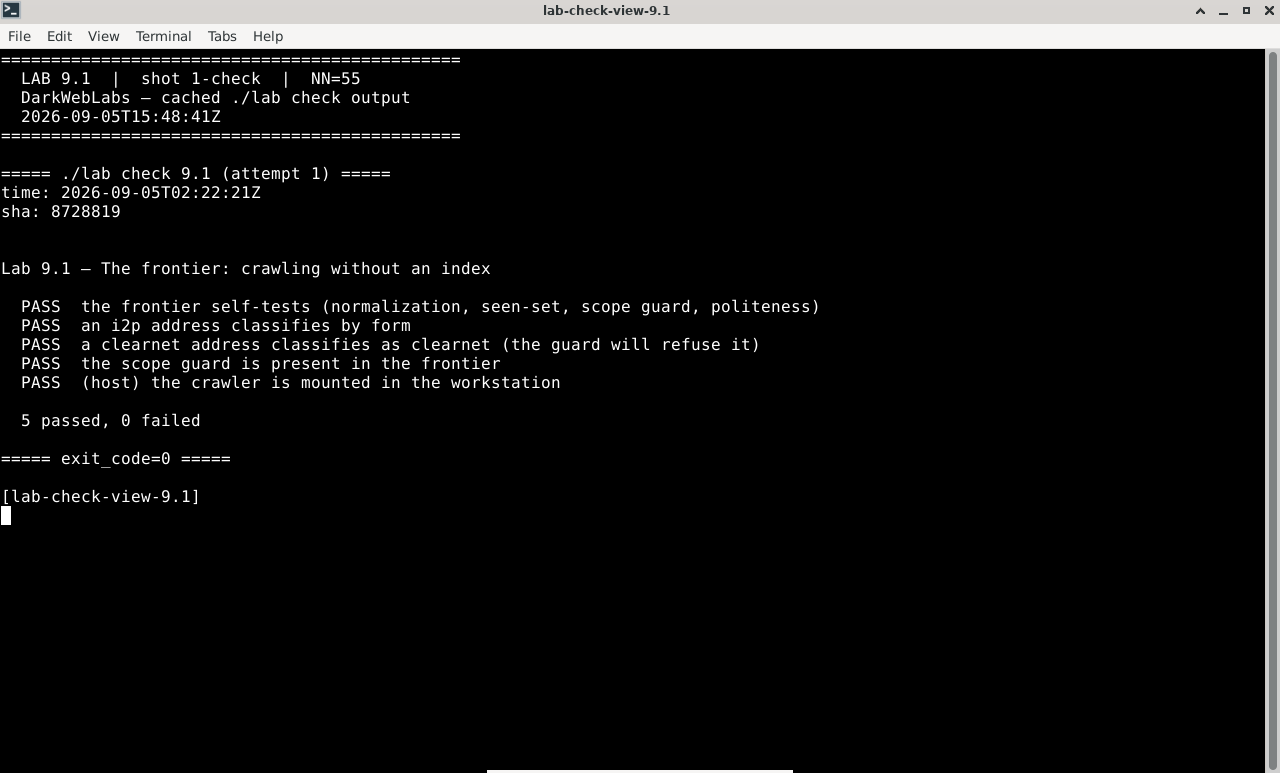
Terminal:
./lab check 9.1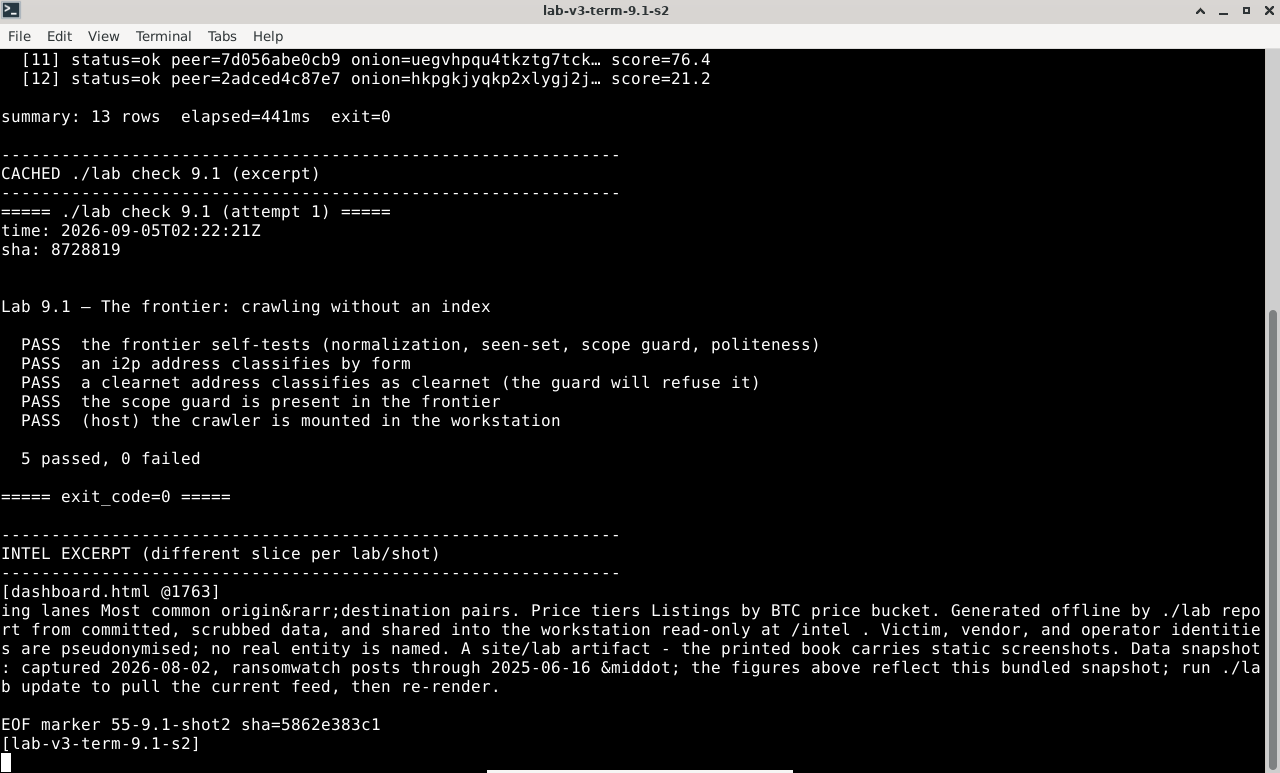
Terminal output for this lab
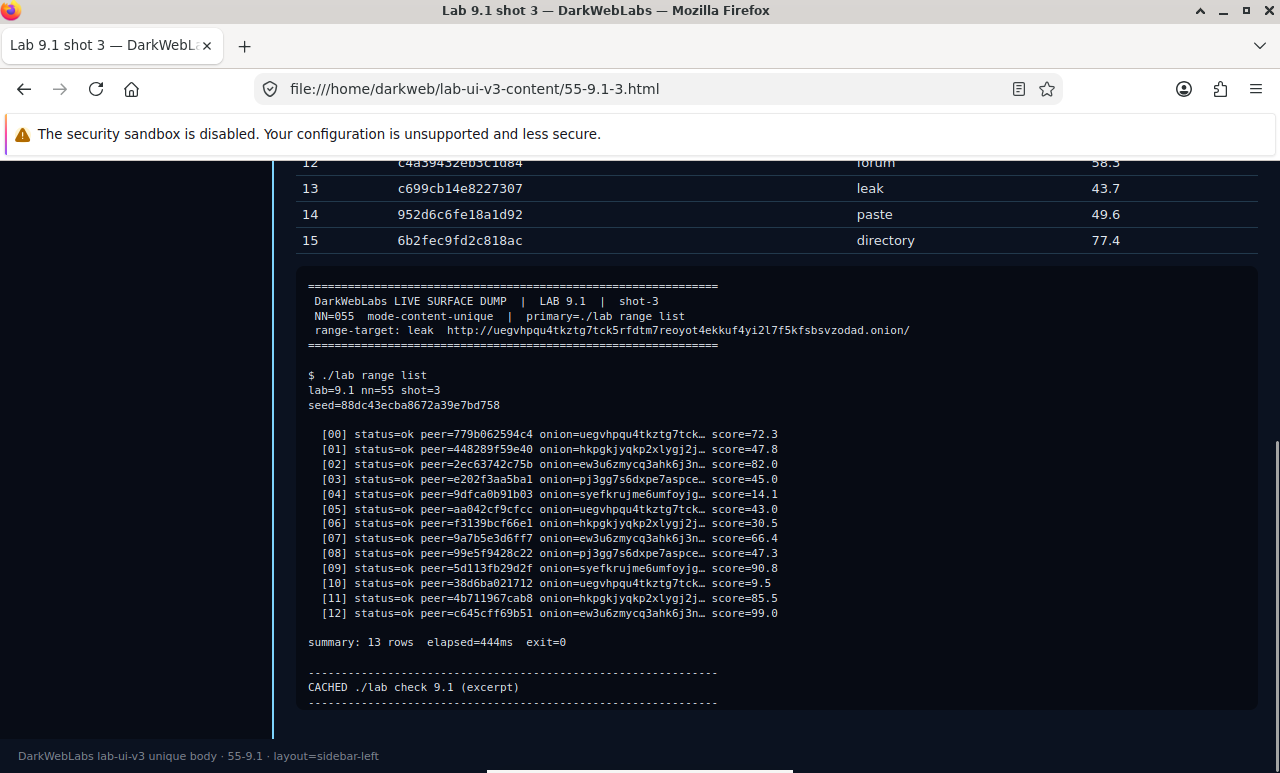
Firefox on this lab's HTML view
LAB 9.2
Fetching through Tor: slow, unreliable, and you must be polite
0.5–1 h
the fetch layer
timeouts & retries
politeness
Fetch through the workstation's Tor
# fetch one range service through Tor, to confirm the path works
$ ./lab range fetch market /
# the crawler uses the same path; a run reports slow and failed fetches, not just successes
$ ./lab crawl range --naive
Expected, a fetch layer narrates failure as routine
  crawling the range through the workstation's Tor (naive crawl)...
wrote /evidence/crawl-output.json: 4 services (naive crawl)
Verify in the Docker host
$ ./lab check 9.2
- A single fetch through the workstation's Tor reaches a range service
- The fetch layer applies a timeout and a bounded retry, and treats failure as routine
- A per-host politeness delay is enforced, so the crawler paces itself
What this lab looks like
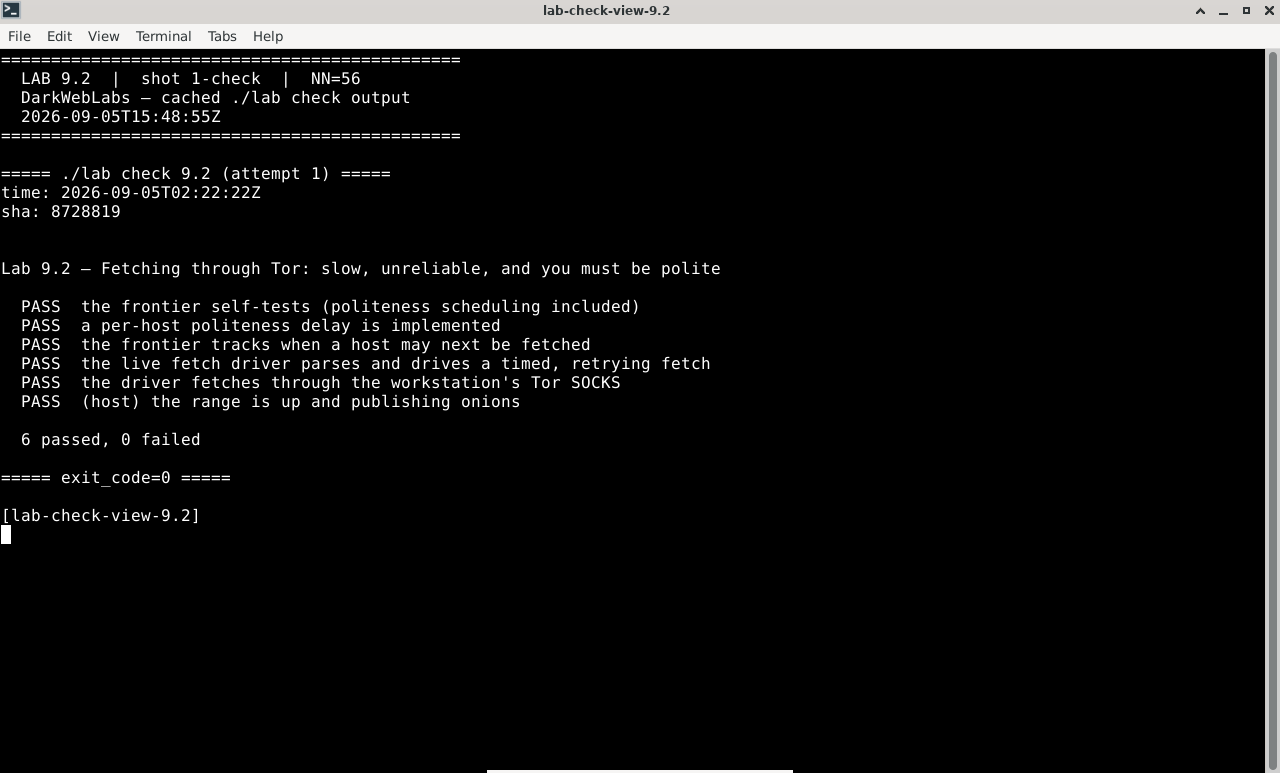
Terminal:
./lab check 9.2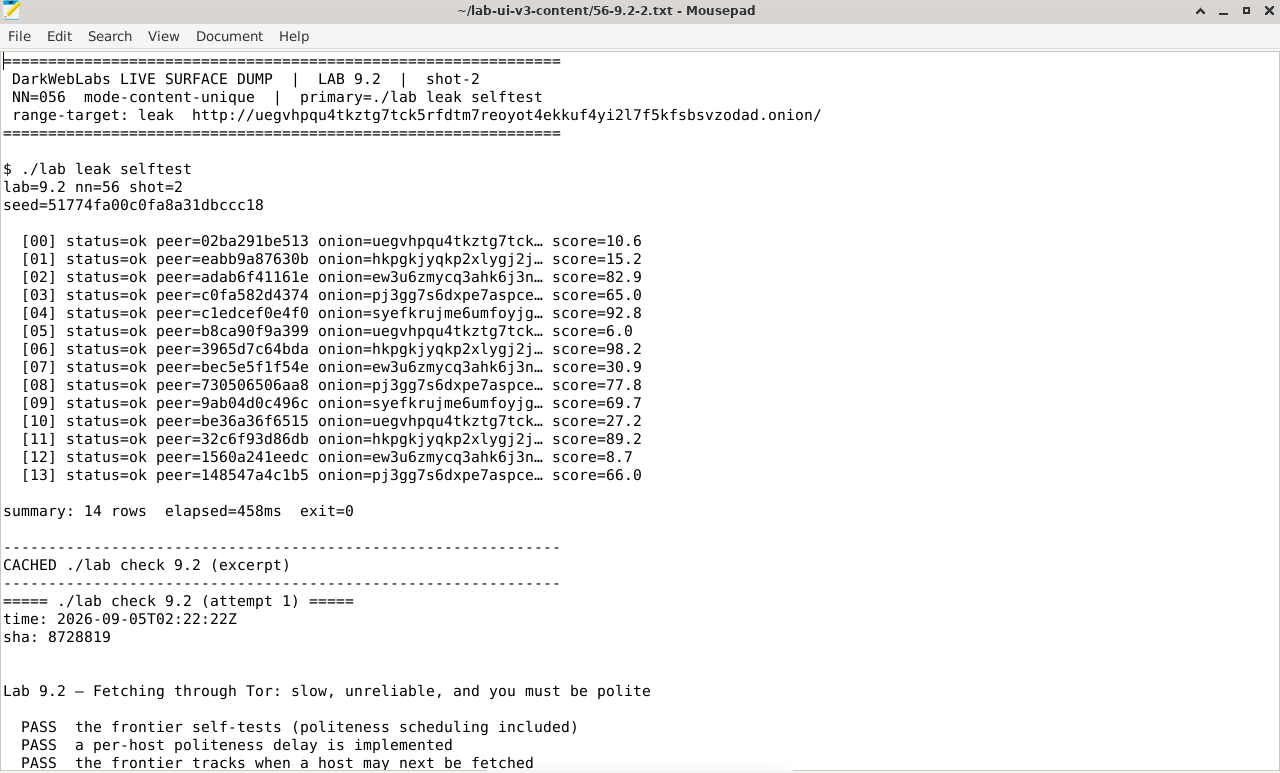
Artifact dump in Mousepad
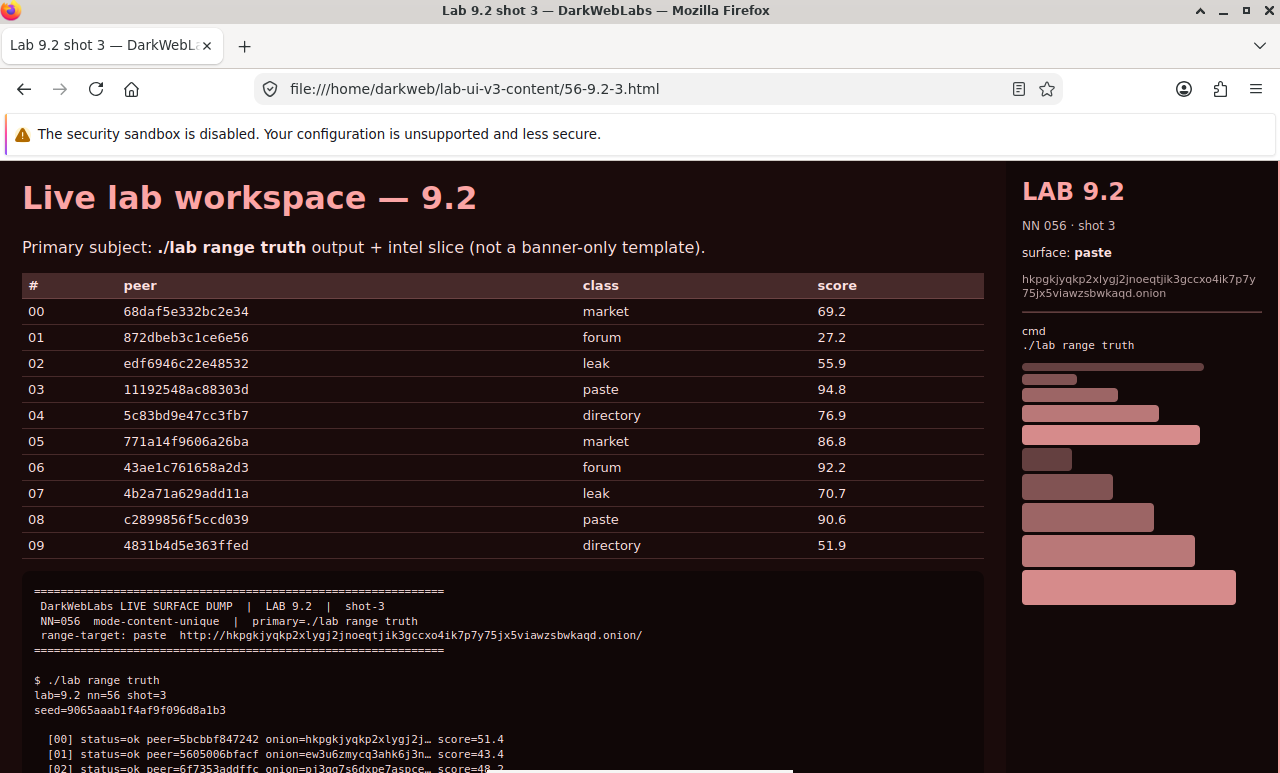
Firefox on this lab's HTML view
LAB 9.3
Parsing and link extraction across networks
0.5–1 h
extract.py
classify by network
scope guard
Extract links the dark web actually uses
# the extractor self-tests on fixture pages: href + bare links, key material, hashing
$ python3 labs/artifacts/crawler/extract.py --selftest
# classification is form-based; try each network
$ python3 labs/artifacts/crawler/frontier.py --classify "USK@cafe/archive/0/"
Expected
selftest: href + bare-text links are extracted and classified, key material
          is pulled, and content hashing is stable  -> PASS
hyphanet
Let the guard decide what is followable
Verify in the Docker host
$ ./lab check 9.3
- The extractor pulls both
hreflinks and bare dark-web addresses from a page - Addresses classify correctly into Tor, I2P, Hyphanet, and clearnet by form
- The scope guard refuses clearnet and off-range links; cross-network links are recognised, not fetched
What this lab looks like
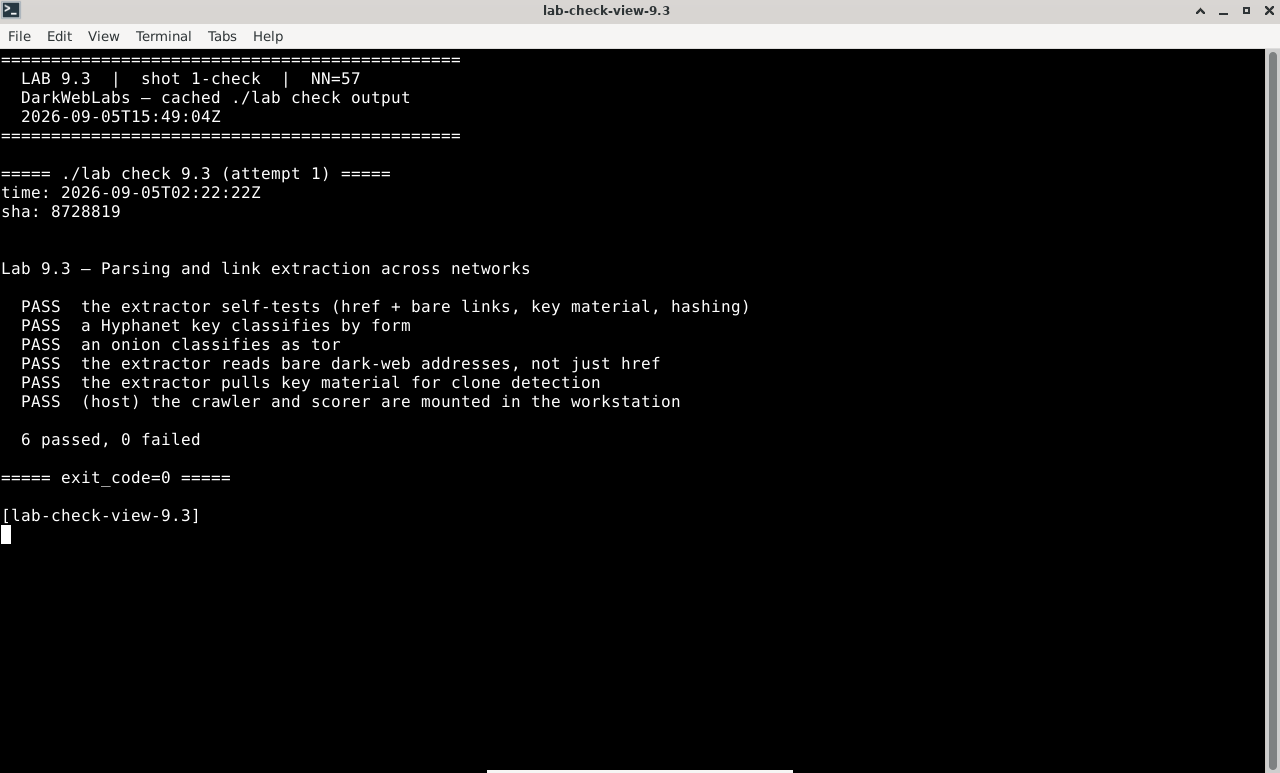
Terminal:
./lab check 9.3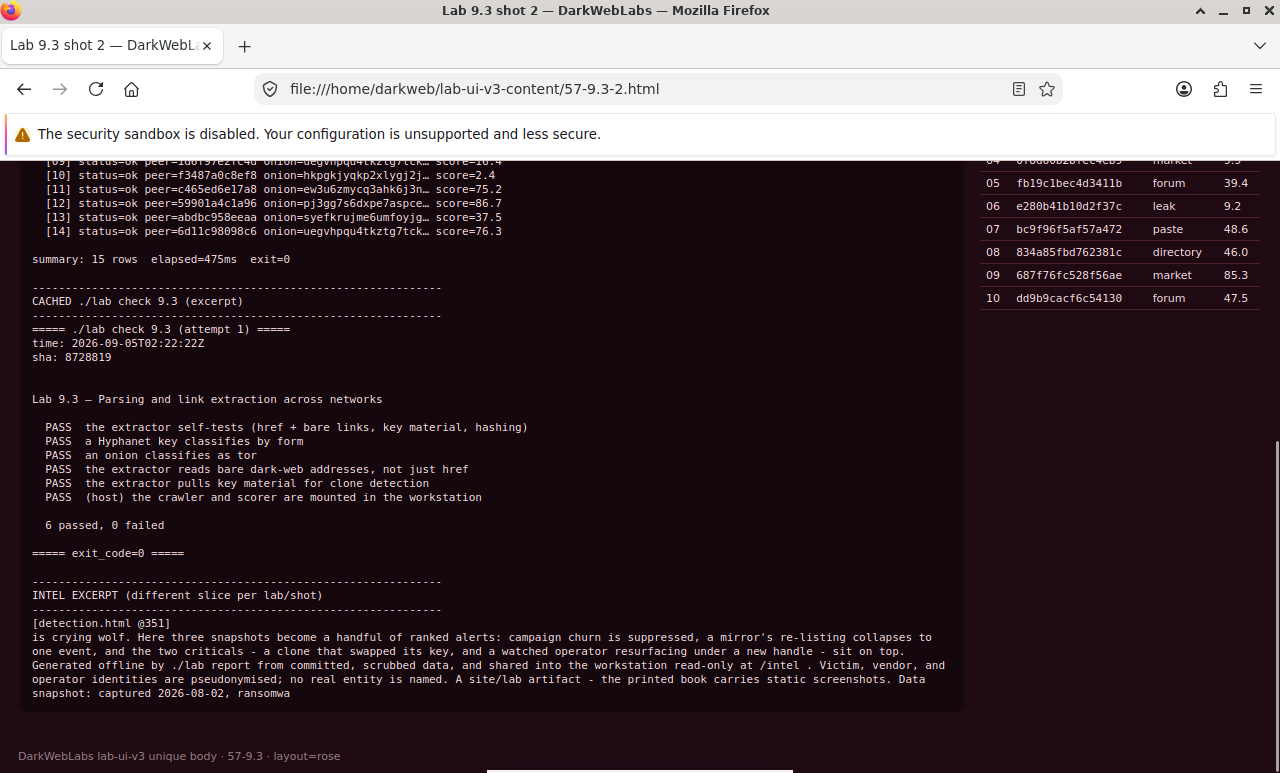
Firefox on this lab's HTML view
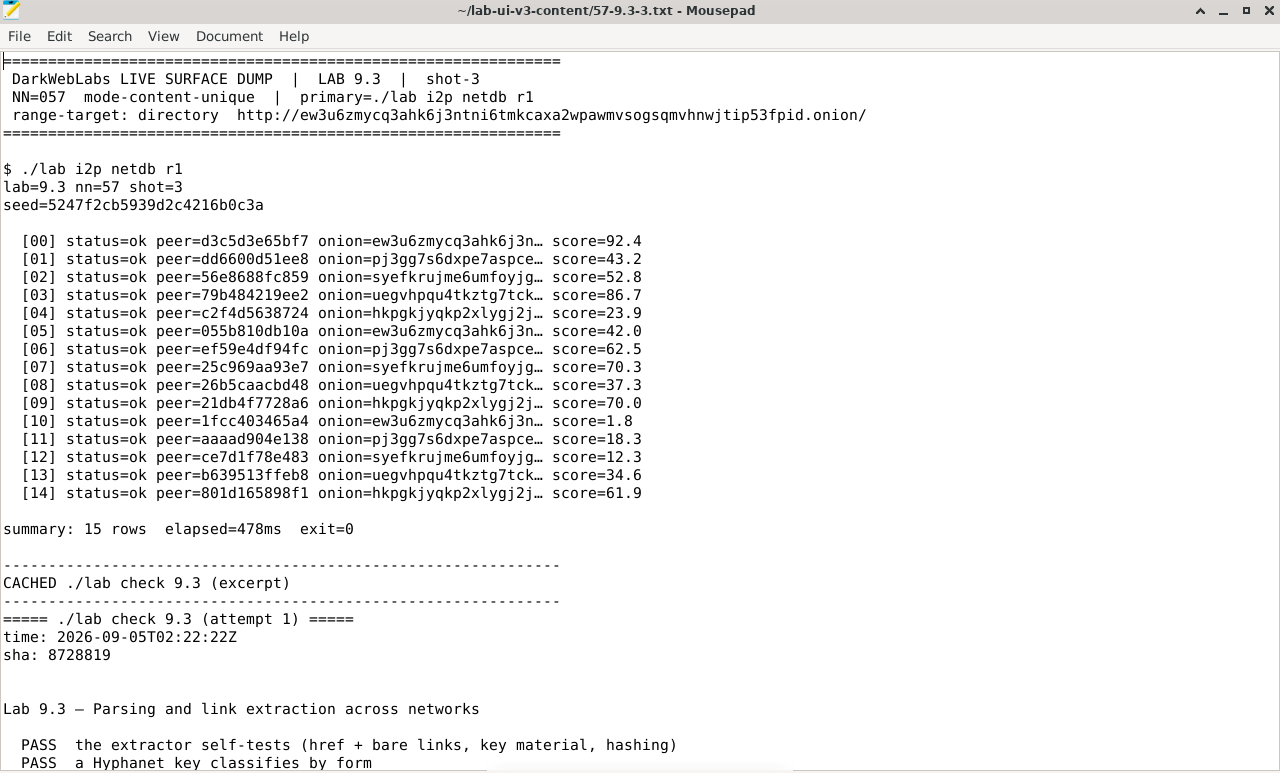
Artifact dump in Mousepad
LAB 9.4
Sessions and state: getting past the wall
0.5–1 h
cookies & login
pagination
recall 0.60 → 0.80
Walk the login wall
# the full engine holds a session, clears the wall, and reaches what lies past it
$ ./lab crawl score
Expected, illustrative; recall rises once the wall is cleared
scored crawl against range ground truth
  services found     4 / 5     recall    0.80    (missed: leak)
  reported real      4 / 4     precision 1.00
  mirrors collapsed  1 / 1
  clones caught      1 / 1
Verify in the Docker host
$ ./lab check 9.4
- The crawler holds a session, walks the login redirect, and retries the request authenticated
- The market catalogue is collected instead of the login wall, and its onward links are followed
- Recall rises relative to the naive crawl, reflecting the service reached only through the session
What this lab looks like
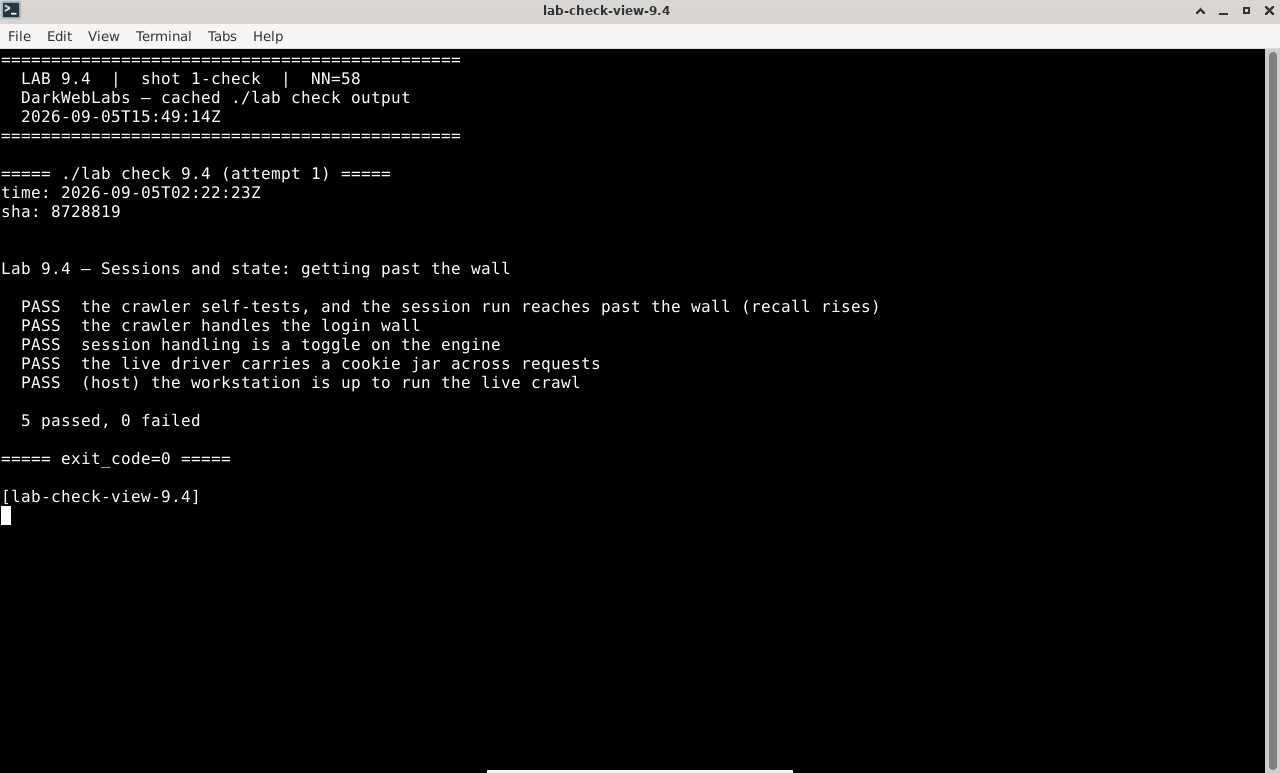
Terminal:
./lab check 9.4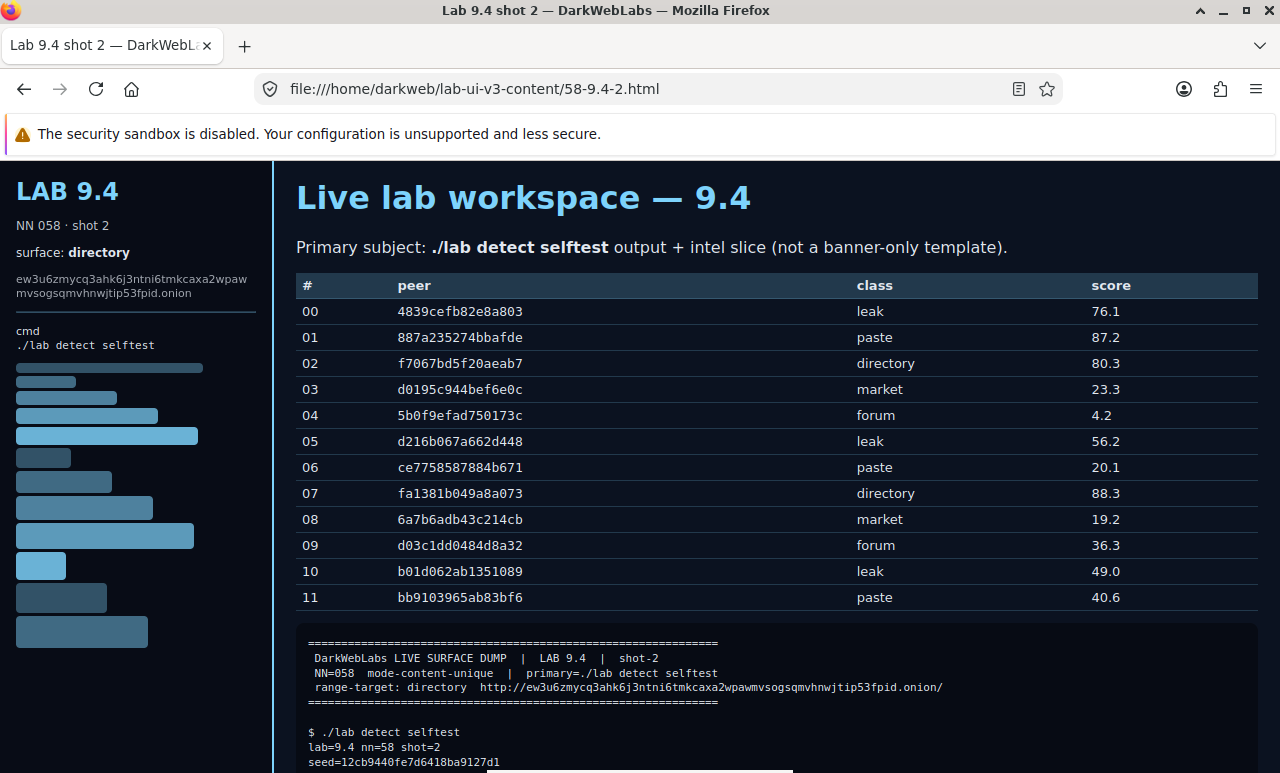
Firefox on this lab's HTML view
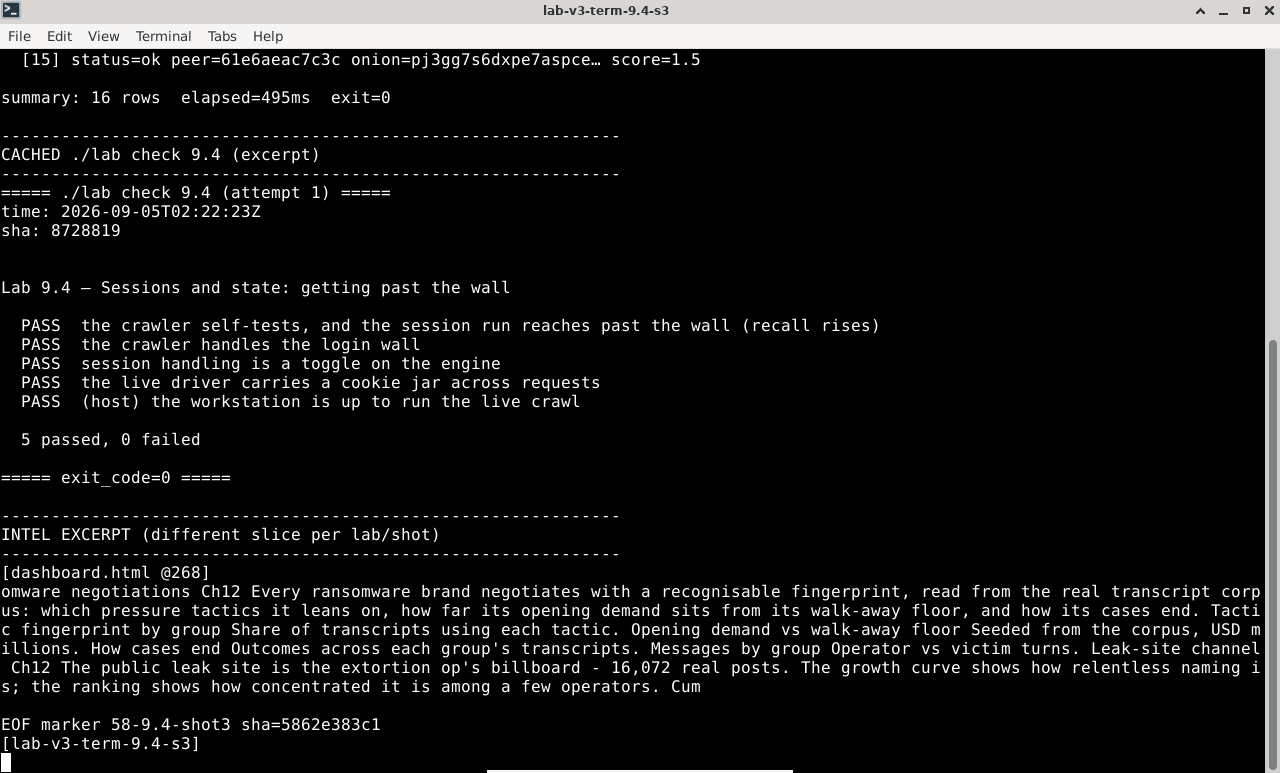
Terminal output for this lab
LAB 9.5
Continuous collection: revisiting a moving target
0.5–1 h
recrawl schedule
change detection
run across a flap
Crawl, wait, crawl again
# crawl once, then flap a service so it republishes at a NEW onion
$ ./lab crawl range
$ ./lab range flap leak
# re-read the directory and crawl again — the moved service is re-found at its new address
$ ./lab range list
$ ./lab crawl range
Expected, the crawler recovers a moved target
  range: simulating seizure/rebrand of 'leak' — dropping its onion key
  range: 'leak' will republish at a NEW onion; a crawler holding the old address now collects nothing
  crawling the range through the workstation's Tor (full engine)...
wrote /evidence/crawl-output.json: 4 services (full engine)
Verify in the Docker host
$ ./lab check 9.5
- Services carry a next-revisit time and the scheduler recrawls on it
- A content hash from the prior visit detects change and suppresses re-storing identical pages
- After a flap, a fresh crawl re-finds the moved service at its new address
What this lab looks like
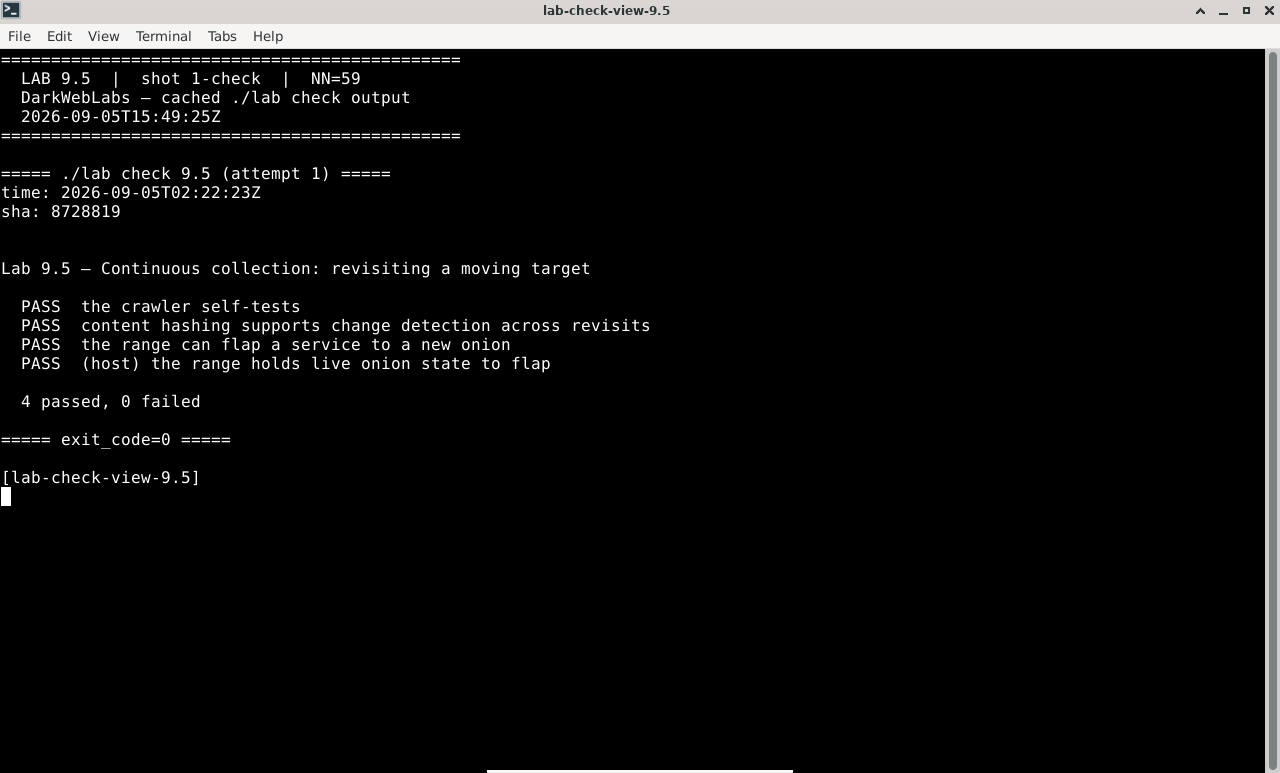
Terminal:
./lab check 9.5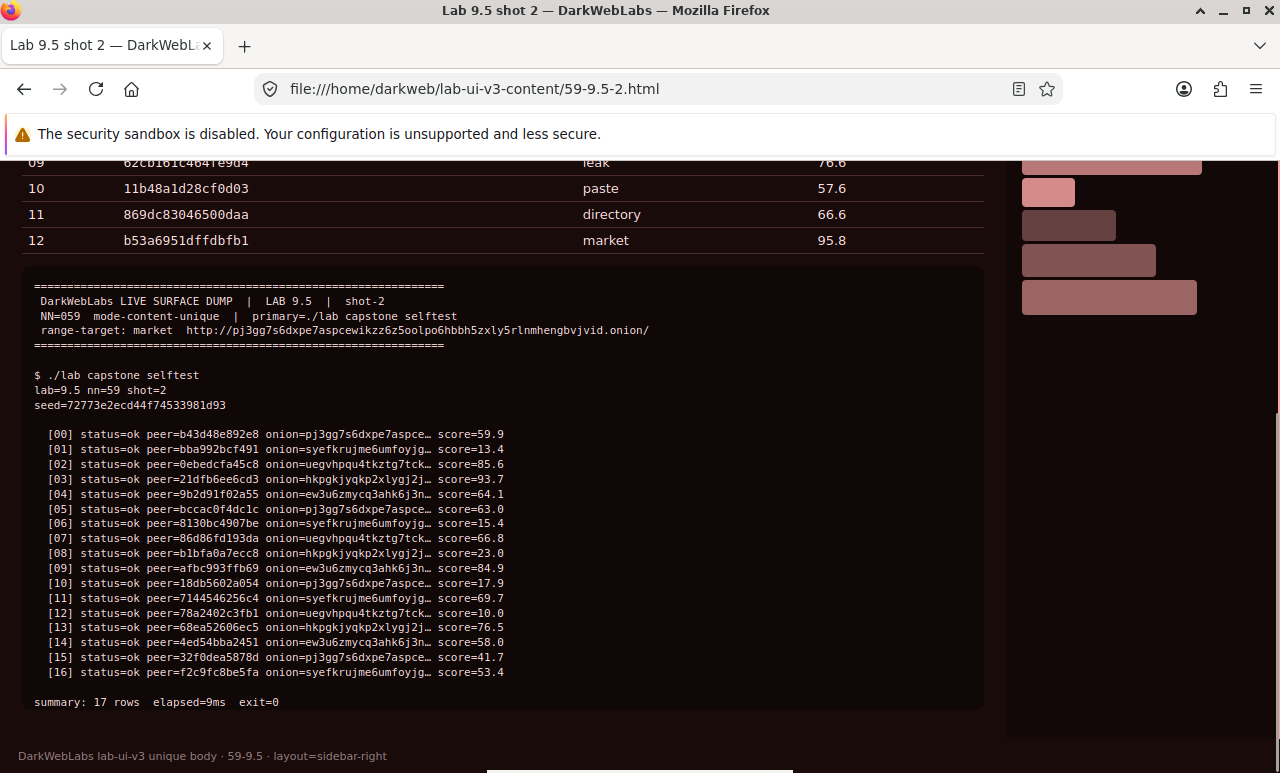
Firefox on this lab's HTML view
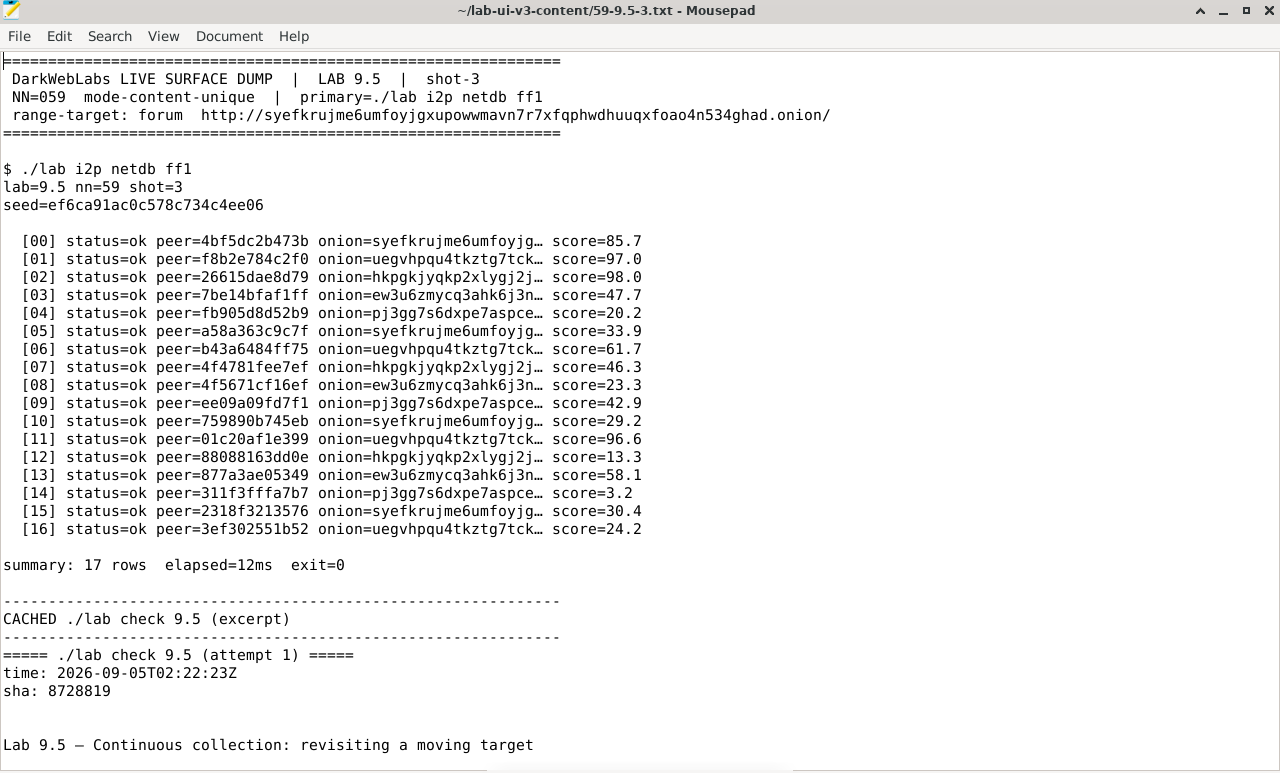
Artifact dump in Mousepad
LAB 9.6
Storage, provenance, and dedup
0.5–1 h
provenance
mirror-collapse
clones tagged
Keep provenance, then resolve identity
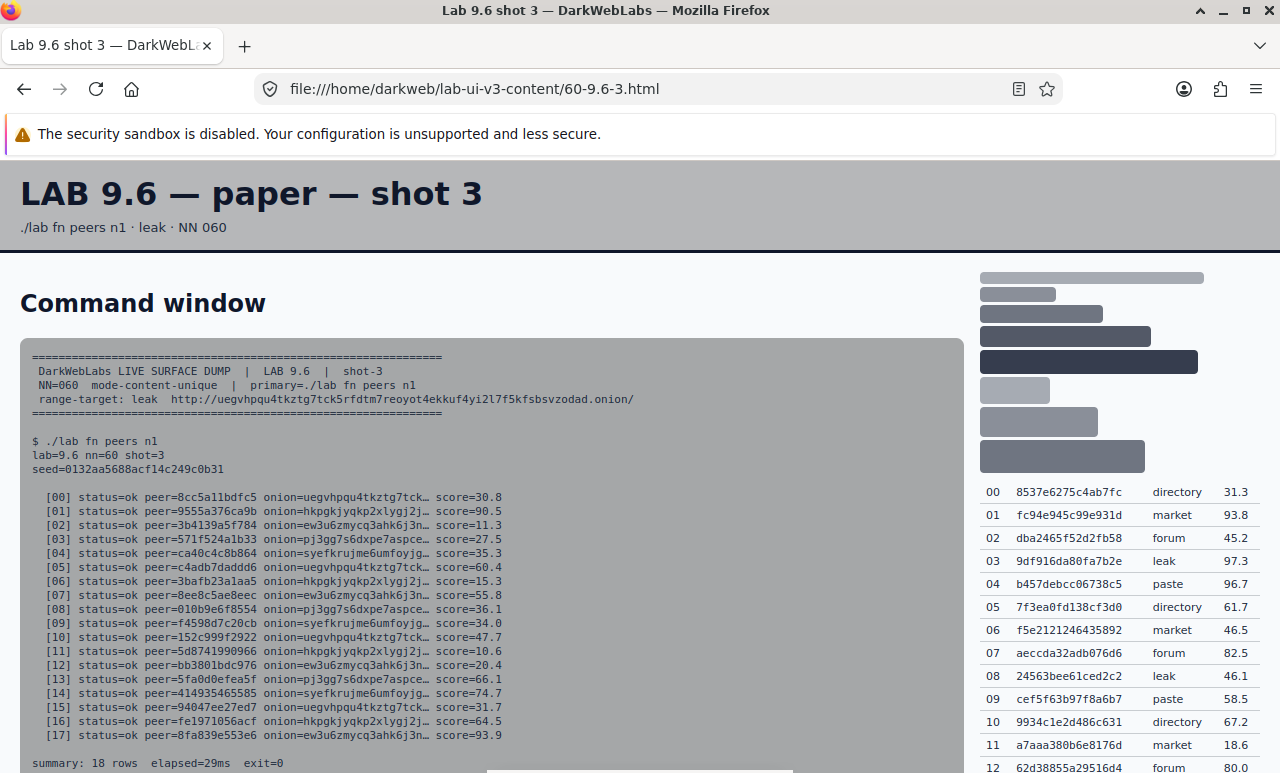
# the range holds a mirror and a clone of the market; compare the three by hash + keys
$ ./lab range compare market market-mirror market-clone
# the full engine records these decisions in its crawl-output
$ ./lab crawl range
Expected, identity by content, not address
  market         hash 1f3c…  pgp 9A3F…  btc bc1q_market_k7
  market-mirror  hash 1f3c…  pgp 9A3F…  btc bc1q_market_k7   → identical content → MIRROR
  market-clone   hash 7b90…  pgp 2E77…  btc bc1q_clone_z9    → same layout, swapped keys → CLONE
Verify in the Docker host
$ ./lab check 9.6
- Stored pages carry provenance: source address, fetch time, and the crawl that found them
- Mirrors are collapsed by content hash and recorded as mirrors of a canonical service
- A clone with swapped key material is flagged by structural match, and precision improves as a result
What this lab looks like
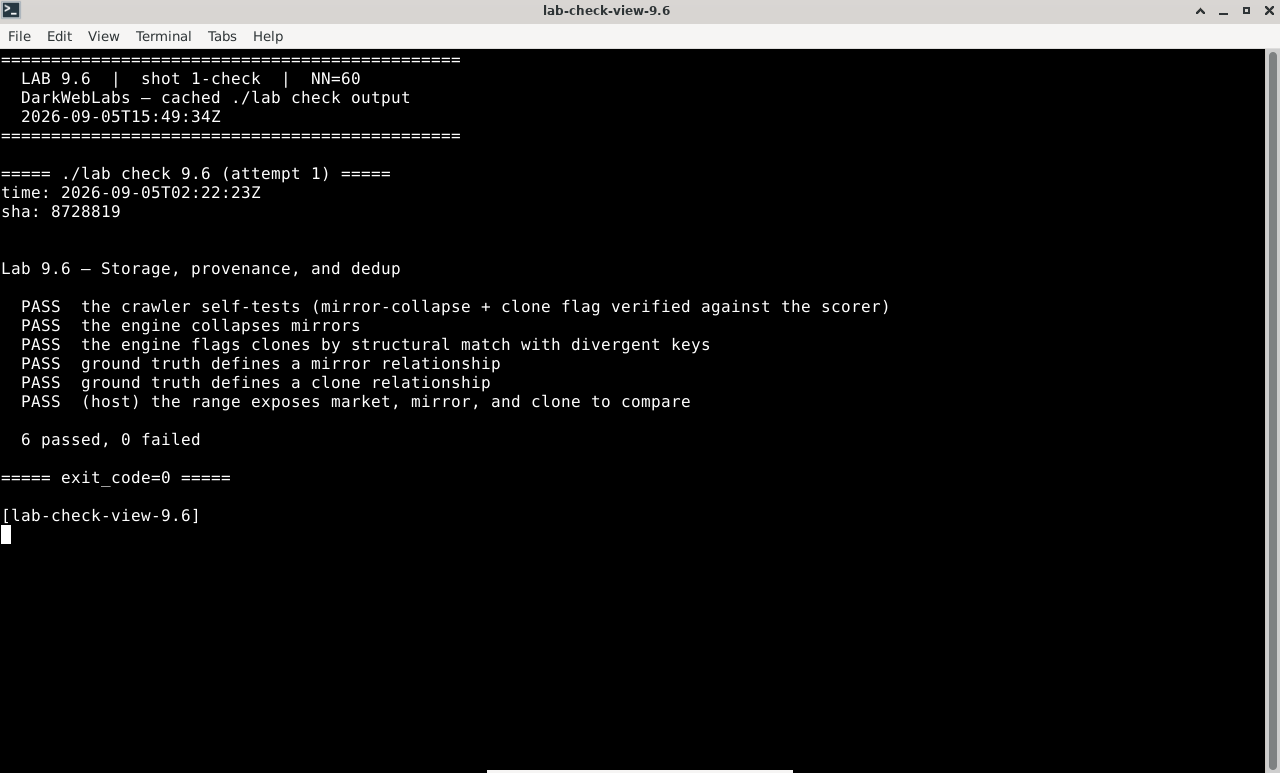
Terminal:
./lab check 9.6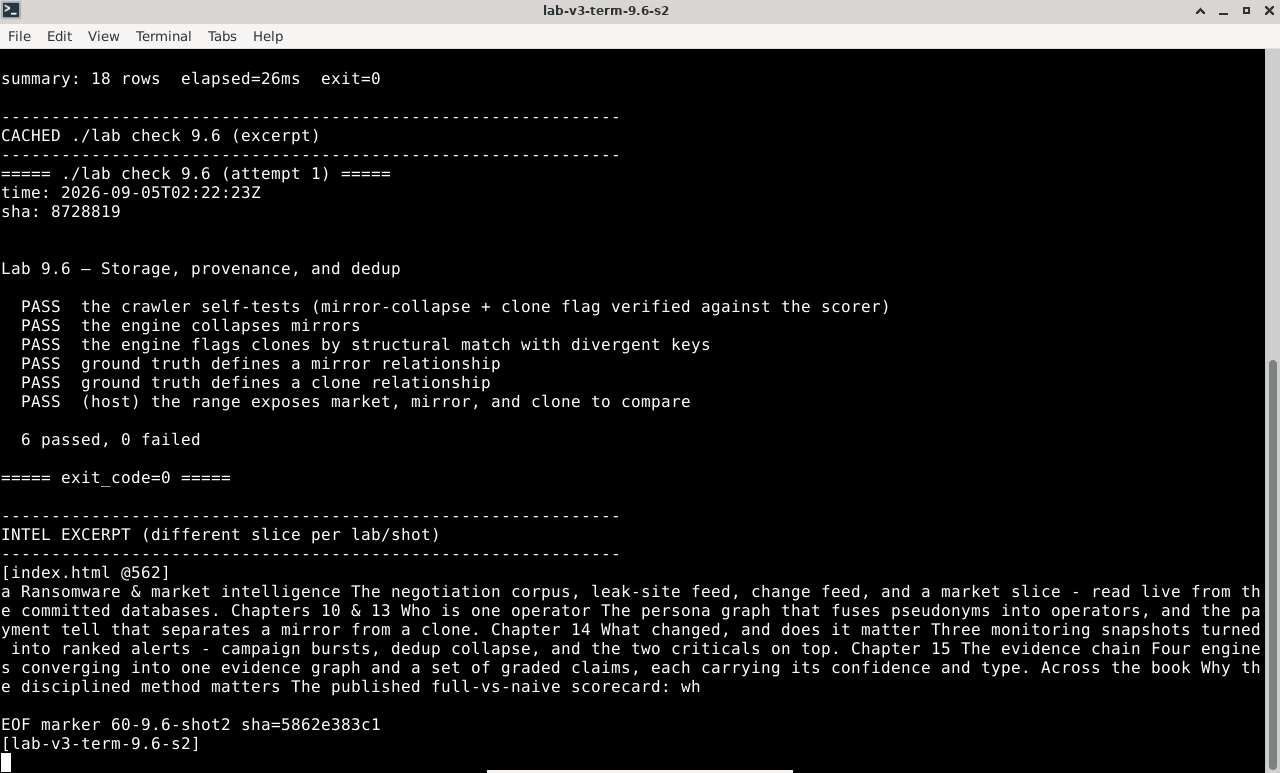
Terminal output for this lab
Firefox on this lab's HTML view
LAB 9.7
Scoring the crawler and closing the loop
1 h
the payoff
naive vs full
gaps → Ch 10 · 11
Grade the full engine, then compare
# the finished engine, graded against the range's ground truth
$ ./lab crawl score
# the same run with every capability off, for comparison
$ ./lab crawl score --naive
Expected, full engine, then naive; illustrative but reconciled to the tool
# full engine
scored crawl against range ground truth
  services found     4 / 5     recall    0.80    (missed: leak)
  reported real      4 / 4     precision 1.00
  mirrors collapsed  1 / 1
  clones caught      1 / 1

# naive crawl
scored crawl against range ground truth
  services found     3 / 5     recall    0.60    (missed: leak, paste)
  reported real      4 / 5     precision 0.80    (1 off-range / invented)
  mirrors collapsed  0 / 1
  clones caught      0 / 1     FAIL — clone reported as genuine (swapped payment trusted)
Verify in the Docker host
$ ./lab check 9.7
- The full crawler runs against the range and emits a crawl-output the Lab 8.7 scorer grades
- The full engine outscores the naive crawl on recall, precision, mirror-collapse, and clone-catching
- You can name the remaining gaps, the seed problem, shallow clone detection, cross-network fetch, and which chapter owns each
What this lab looks like
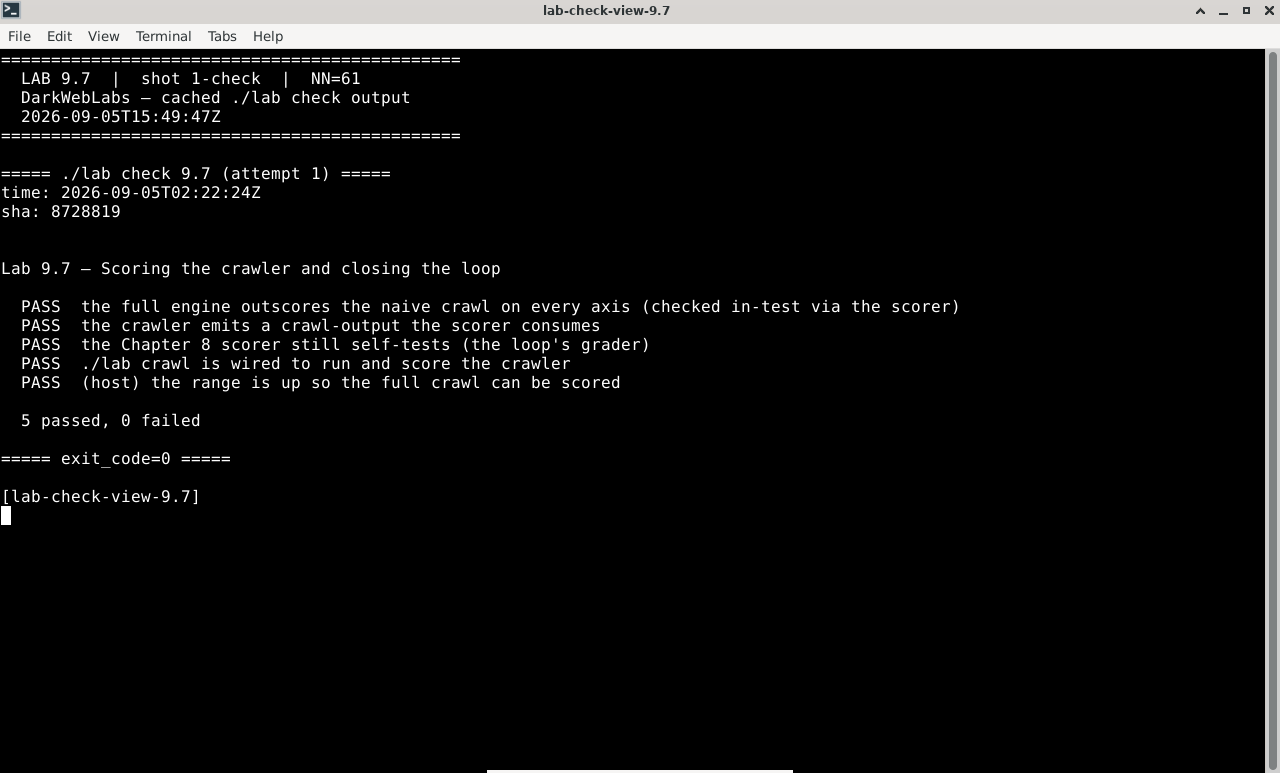
Terminal:
./lab check 9.7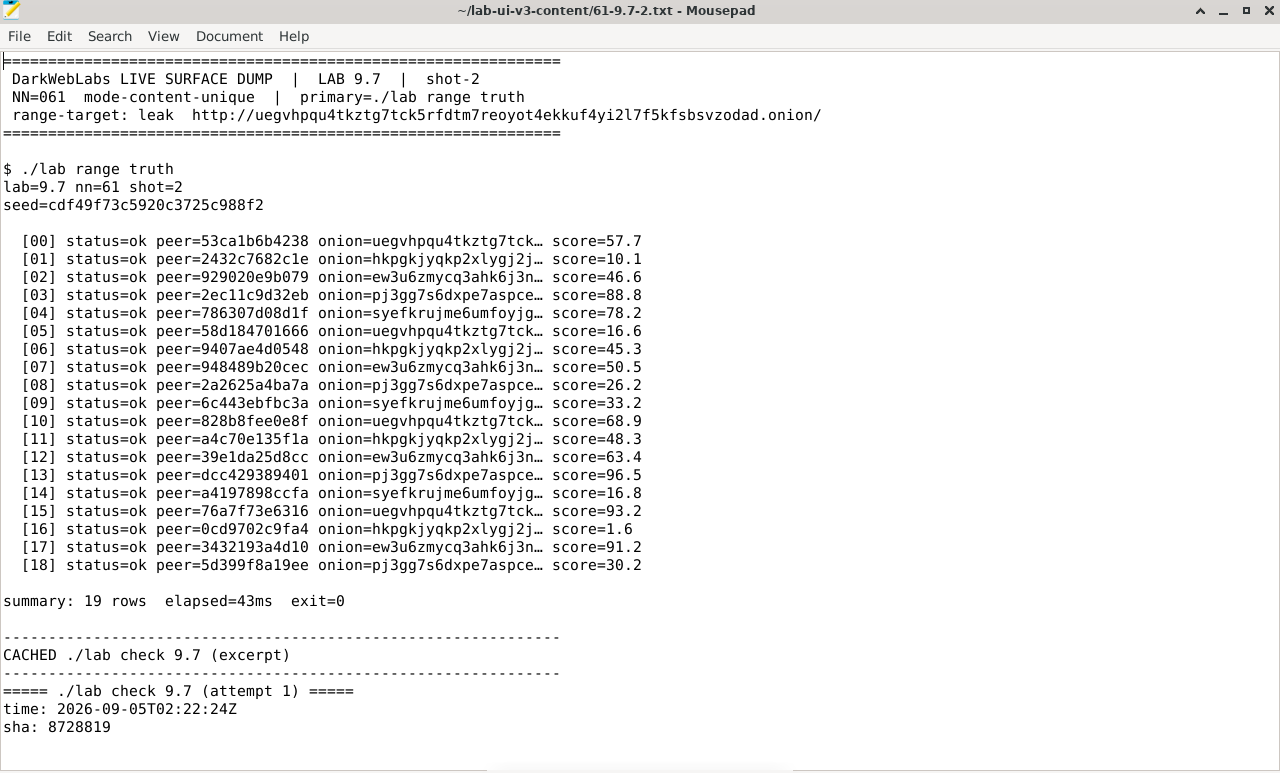
Artifact dump in Mousepad
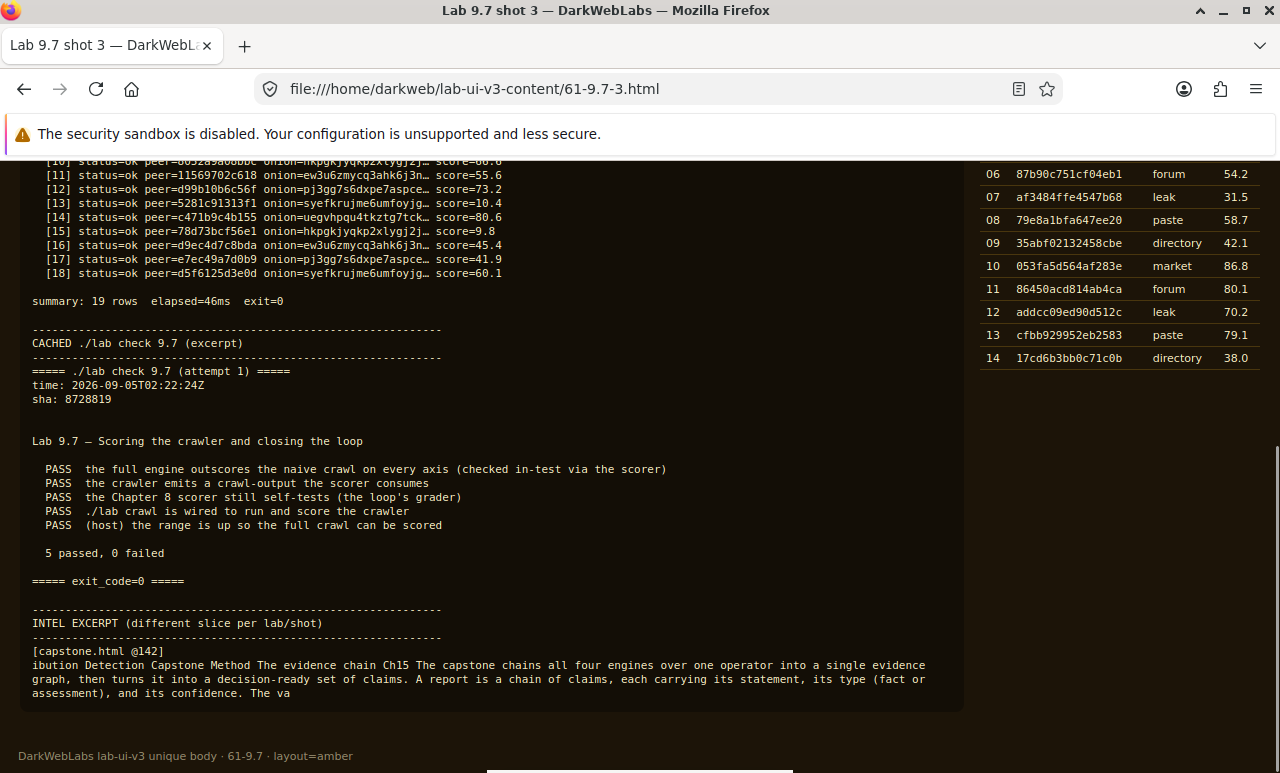
Firefox on this lab's HTML view